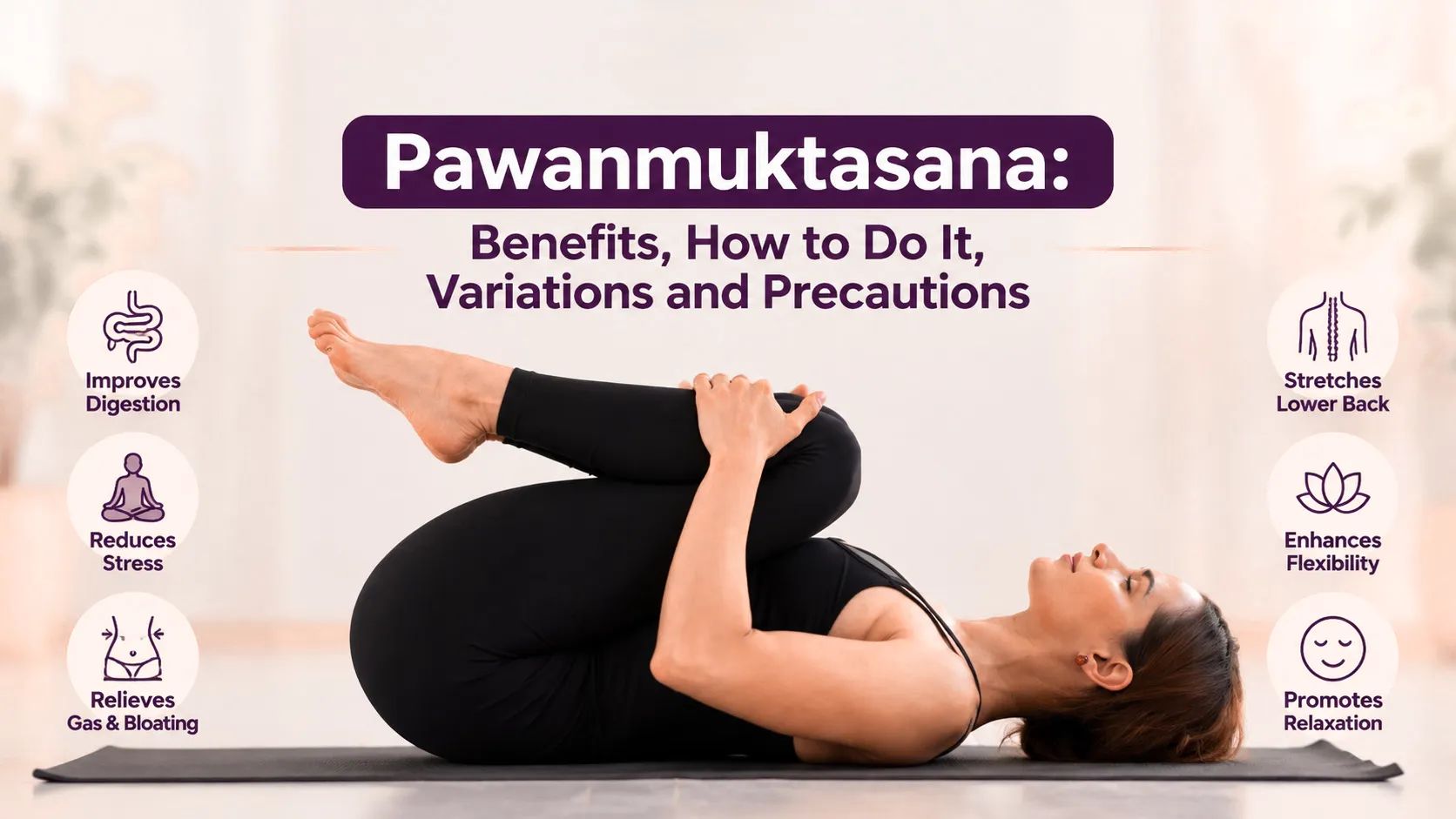
As the name of this popular yoga pose suggests, it is a wind-relieving pose. Those who suffer from gas and constipation regularly, can try out Pawanmuktasana for quick relief. This pose or asana helps in the movement of gas in the intestines and relieves pressure in the abdomen. You should practice the same in the morning. However, those who are beginners or have some knee issues must take it slow.
So, let us get into the complete details of this useful asana.
What Is Pawanmuktasana?
The Pawanmuktasana as the name suggests is a wind-relieving pose as mentioned before. Let us learn the Sanskrit meaning of this pose.
Sanskrit Name: पवनमुक्तासन
- Pawan – air
- Mukta – release
- Asana – pose
Pawanmuktasana has a deep connection with the Ayurvedic tridoshic concept. Vata is a primary component here, which resides in the large intestine. Pitta helps in digestion, while the third, Kapha helps in holding things together. Doshas do not exist in material form, but affect qualities. When Vata is released, the wind fires the Pitta, and it in turn purifies the water in Kapha. When there is no movement, it can cause stagnation, disease and degeneration of tissues. There are both single leg and double leg variations for practitioners.
How to Do Pawanmuktasana Step by Step
Let us understand the main pose in the Pawanmuktasana series.
Preparation For The Pose
- Warm up prior to starting with Pawanmuktasana.
- Start in Savasana to relax a bit. It will help in cantering your mind.
- Do some gentle knee circling, to improve hip and joint mobility.
- Thereafter, do Cat-Cow pose.
- After you are done, do Apanasana.
How To Do The Main Pose
- Lie on your back, with both legs extended. Your arms should be by your side, palms down. Breathe slowly.
- Press your lower back muscles downward gently and while engaging your ab muscles, exhale.
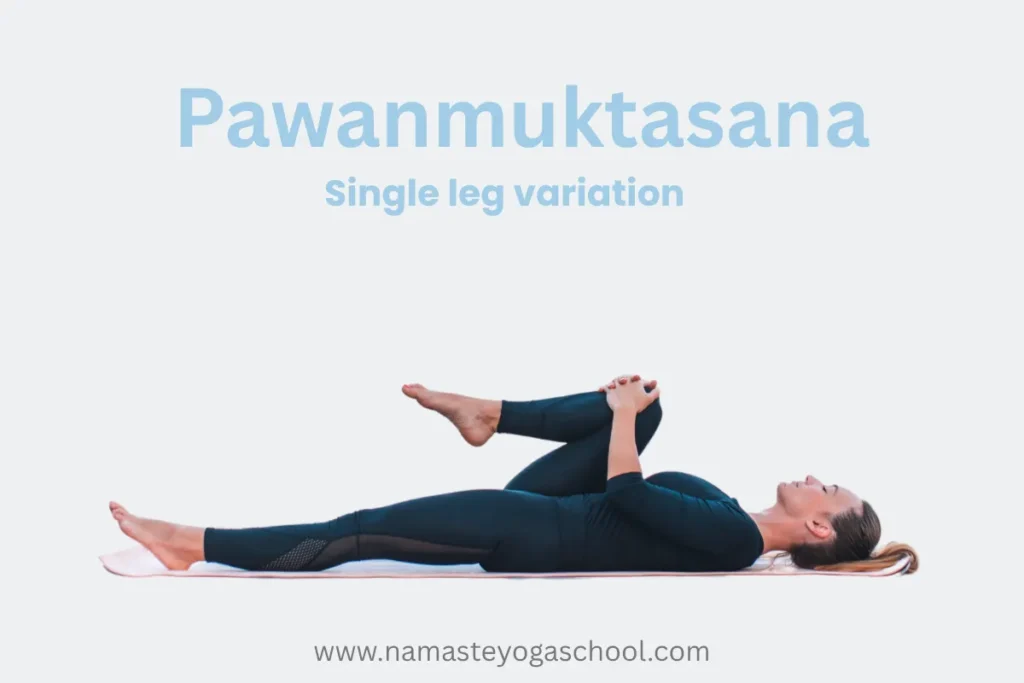
- Inhale and bend one knee, and bring it towards the chest. The other leg stays stretched on the floor, in case you are attempting the one-legged variation.
- Interlock the fingers around the knees, or behind the thighs for beginners.
- Exhale and bring the knee closer to the armpit on the same side.
- Ensure to keep your shoulders relaxed.
- You must maintain light pressure on the abdomen.
- Keep on breathing normally.
- Exhale and stretch out the leg again.
- Perform the same motion on the other side.
- Relax both legs in Savasana.
When you do the double-legged variation of Pawanmuktasana, you draw both knees together towards the chest. Rather than bringing them towards the chin, the focus must be on aligning them towards either armpit.
Benefits of Pawanmuktasana
- When done regularly and properly, it helps in increasing the muscular contractions which aid in digestion. This ultimately results in relieving constipation and also benefits those having irritable bowel syndrome.
- When you practice Pawanmuktasana regularly, it can help in improving your blood circulation. Unlike forward fold poses, it does not create unnecessary pressure on the abdomen. It strengthens the abdominal muscles and increases blood circulation. As one lifts the legs above the heart, the blood flow to the heart is also improved.
- When practiced under supervision, it helps in regeneration of the pancreatic cells, improving glucose absorption, and which ultimately lowers the amount of glucose in the blood stream.
- It also affects the lymphatic system, which is connected to immunity. Pawanmuktasana stimulates the flow of lymph towards proper drainage points in the body.
Pawanmuktasana Variations for Beginners
- Single Knee Pawanmuktasana – In this variation, only one knee will come towards the chest, while the other knee will be extended straight.
- Double Knee Pawanmuktasana – Both your knees will move towards the chest in this version.
- Head Down Pawanmuktasana – Your head is on the ground.
- Rocking Variation – You can rock the body towards the front and back in this version.
There are a few beginner-friendly modifications, which you can try as well.
- With Strap – This one reduces strain on the shoulders and hips. Those who have limited flexibility can try this.
- Bent-knee Support – This is easy on the lower back and your hamstrings.
- Wall-assisted Version – This is a great option for prenatal practice. You have complete stability and support.
How Long Should You Hold Pawanmuktasana?
- You can hold the pose for five breaths initially. If you calculate by time, it is 10 seconds to a minute.
- Inhale while extending the legs and exhale while pulling the legs towards the chest.
- You must ensure to keep the shoulders and elbows relaxed.
- Do not press the thighs too tight, as that can restrict breath.
- Do not curl up the pelvis region, allow it to stay on the floor.
Common Mistakes to Avoid
- Lifting Your Head Or Neck – This is one of the most common mistakes you must avoid. Keep the head touching the floor or mat, and chin tucked into the chest cavity.
- Pulling Knees To Close To The Face – You must avoid this, as it can restrict your breathing.
- Forcing Yourself Into The Pose – You must ensure not to exert too much force on the knees and back. Use props if required.
- Holding Your Breath – You must ensure to breathe rhythmically, as otherwise, your digestion can be slowed.
- Extended Leg Off The Ground – Avoid this, as it can create imbalance. Your extended leg must be kept straight on the ground.
Precautions and Who Should Avoid It
Although Pawanmuktasana is a pose which everyone can practice, there are specific situations and conditions, when you must exercise caution, avoid it or modify it.
- Avoid:
- If you had a recent surgery in the abdomen.
- If you are suffering from hernia.
- If you recently had eye or heart surgery, avoid it.
- You must avoid it in the advanced stages of pregnancy.
- Those suffering from severe osteoporosis must avoid it.
- Those who have undergone recent hip surgery or knee replacement, must avoid it.
- Modify:
- If you have high blood pressure, go for variations.
- You may do it in the first trimester.
- Those with chronic indigestion must modify it.
- In menstruation, you must not put too much pressure.
- Those having lower back pain must exercise caution and try a modified version.
- If you are in the post-partum phase, modify it.
Conclusion
Thus, you now have a complete know-how of how you must approach the asana. This is a beginner-friendly asana, which still needs guidance initially. You must ensure to follow the precautions and dos and don’ts. Try out the modified versions, or use props, where and when necessary.
Frequently Asked Questions

- Pawanmuktasana: Benefits, How to Do It, Variations and Precautions - November 10, 2026
- The 10 Best Yoga Teacher Training in India 2026 - June 2, 2026
- Malasana (Garland Pose) Benefits, Steps & Variations - June 2, 2026