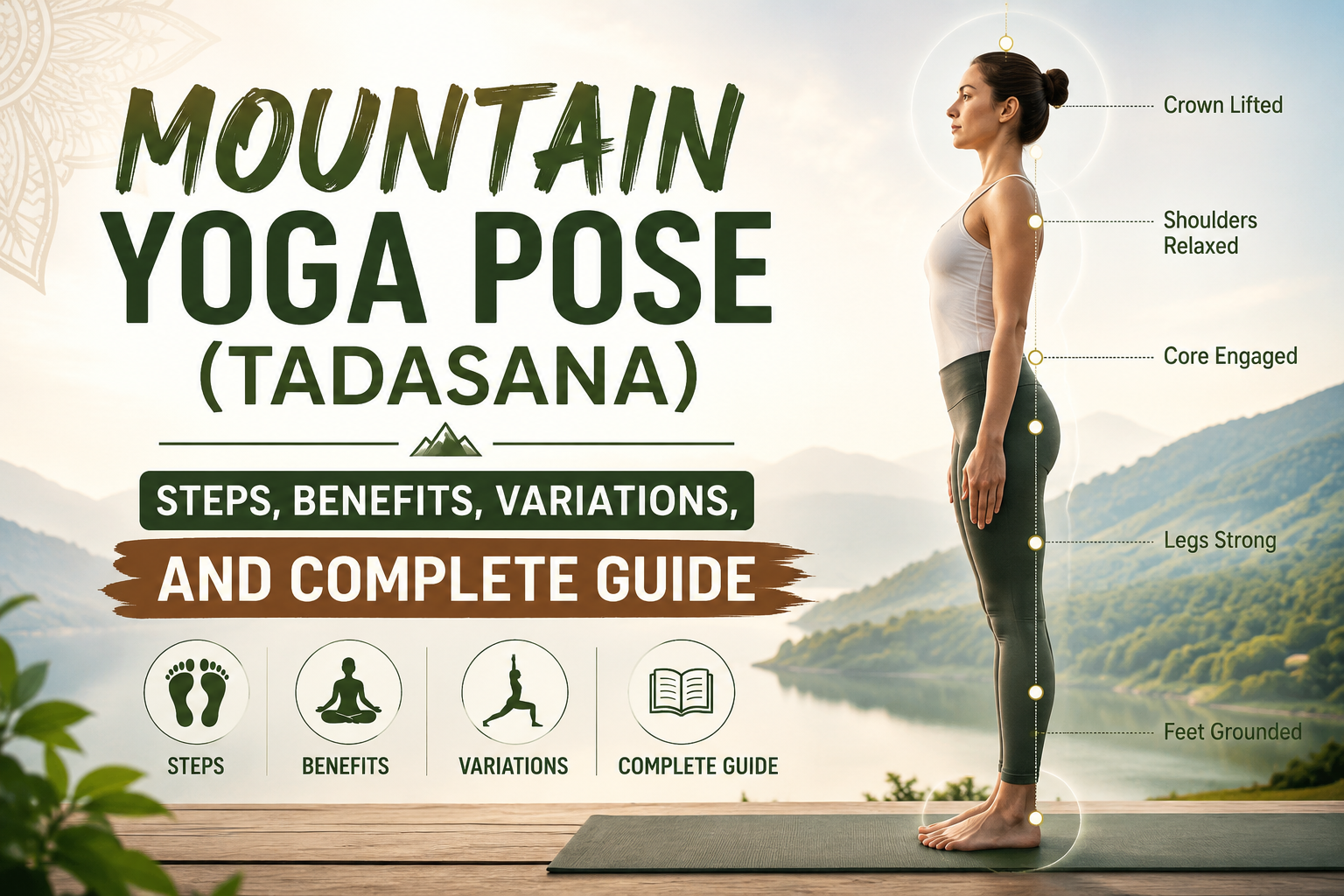
The mountain pose or Tadasana is one of the beginner-friendly yoga asanas that everyone knows of. And it pertains to those who have never done yoga, but have observed someone at least. Although it seems easy, it is important for balance and stability. It can make you aware of the present moment, and also help in grounding. The mountain yoga pose helps you to stabilise the body like a mountain.
Whether you are learning Hatha Yoga, Ashtanga Yoga or Vinyasa Yoga, this is a part of the syllabus.
Sanskrit Of Tadasana (Explanation)
In Sanskrit, Tadasana means ‘Mountain posture’ where ‘Tada’ means mountain and ‘asana’ means posture. In this posture, the body is grounded, stabilised and balanced, standing tall like a mountain. Many yogis also refer to it as Samasthiti. The meaning of ‘Samasthiti’ is ‘equal standing pose’.
How To Do Mountain Yoga Pose (Step-By-Step Instructions)
You can perform this asana, under the guidance of a trained individual. Let us check out the steps for now.
- You must start in the standing posture. You can choose to keep both feet together or slightly apart. Whichever stance you choose, ensure to distribute your body weight on both the feet.
- The arms remain by your side initially.
- Slowly, lift the toes up and then replace them on your mat. You must not be leaning backwards or forward.
- Pull in the knee caps, and squeeze the thighs, tucking the tailbone inwards. Your legs must be straight, but not locked backwards.
- Inhale and lift the torso upwards, moving the crown towards the ceiling. Feel your spine lengthening.
- Slowly spread the hands outwards and lift them, while simultaneously lifting the heels of the floor.
- Balance yourself on your toes.
- Hold the posture for 5-10 breaths. You can also stretch the hands upwards, if you want to.
- After the said time is over, slowly lower your heels. Breathe out, and bring the hands to the original position.
- Stand on your feet laid flat on the mat.
- Relax.
This is the tadasana yoga pose for you. Learn how to do it under the guidance of trained experts to get maximum benefits.
Benefits Of Mountain Pose
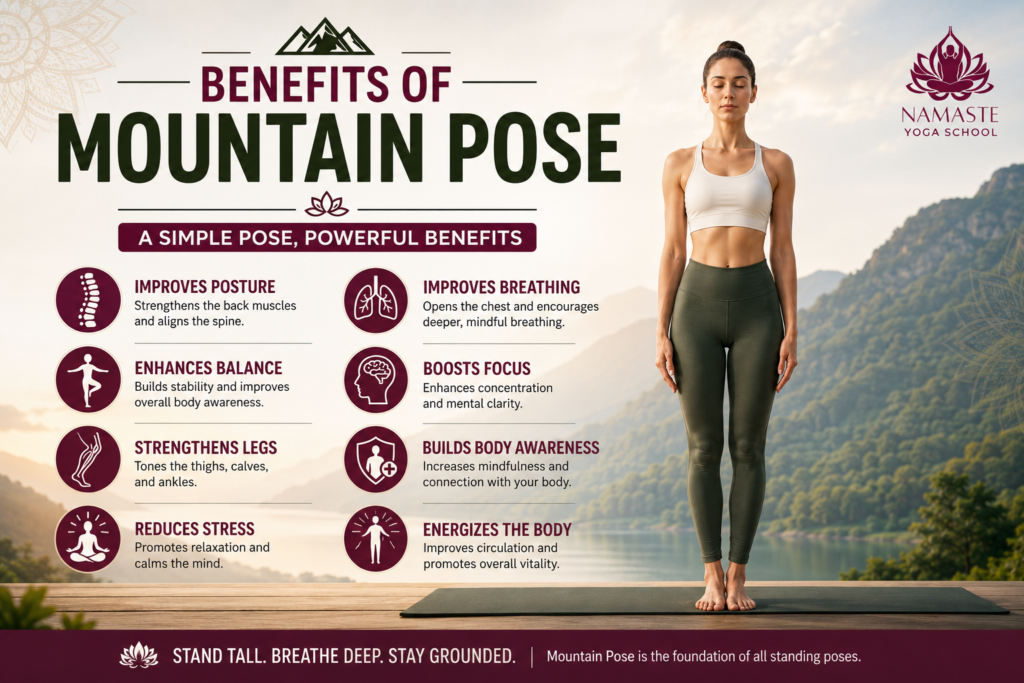
You must know about the benefits of mountain pose, to extract them to the fullest, during practice.
- Tadasana is a beneficial asana for all those who want to give a good stretch to your bodies. It stretches the chest, abdomen, spine and the legs.
- It creates a sense of physical and mental balance. If you practice with closed eyes, then the balance gets enhanced all the more.
- You can also increase your height to a certain extent.
- Those women who are in the early stages of pregnancy also benefit from the practice of Tadasana.
- You can practice Tadasana before or after any inversion posture, to re-direct the flow of blood.
- When you practice Mountain posture daily, your posture improves.
- It also strengthens the muscles of the thighs, knees, and the ankles.
- Your awareness also increases manifold, when you practice Tadasana daily.
- It also makes your breathing perfect.
- It also firms the buttocks and abdomen.
- It helps to remove sciatica.
- Your concentration improves manifold.
- It can help you to rectify flat feet.
Contraindications
- If you suffer from vertigo, you cannot do this pose.
- Those suffering from low blood pressure, cannot practice this pose.
- Those of you, who suffer from migraine or headache, cannot practice this.
- If you are in the later stages of pregnancy, you must avoid the pose.
- Those who have any knee and ankle injury must avoid this pose.
Modifications
Though the pose, Tadasana looks easy, beginners may not find it so. Moreover, standing with the feet apart for some time, does require strength and stamina. You can make this easier, by introducing certain modifications.
- Take support from a wall. You can get a better grip on the mat, this way.
- Those who cannot stand still with feet slightly apart for long, can increase the gap for more stability. Once you get used to it, then you can slowly reduce the distance.
- You can also place a block between the back and wall. This will prevent the chest from falling.
- If you have difficulty in raising the lower back and hip, place a block between the lower back and wall.
- You can keep your eyes open in the beginning, and slowly switch to closed eyes.
- You can place a folded blanket below the feet initially, if keeping the feet on the mat for a long time becomes a challenge.
Variations
There are quite a few variations of tadasana yoga pose. Let us study about them here.
- You can try the Supta Tadasana variation. It is also called the reclined mountain pose. You are supposed to perform this lying down on the mat.
- Then there is an Urdhva Hastotanasana or Palm Tree pose. You have to interlock the fingers of the hands above your head, while stretching them fully.
- You can also try the Utthita Tadasana, or Five Pointed Star pose. In this pose, you extend your four limbs as much as possible, to their full capacity.
Counter Poses Of Tadasana Yoga Pose
The counter poses for Tadasana are:
- Uttanasana or Standing Forward Bend Pose
- Adho Mukha Svanasana or Downward Facing Dog Pose
- Balasana or Child Pose
Tips For Practicing Mountain Pose
- If you are a beginner, separate the feet as much as necessary. Try to make the legs strong and stable.
- Feel yourself lengthening through the lower back, as you grow taller.
- Drop your tailbone towards the floor, while you are in the pose.
- If you are an advanced practitioner, and still lack balance, then close your eyes and find balance.
- You can also perform bandhas to remain in this pose.
Anatomy
- You must ground yourself through the feet. And then expand the toes. De-compress the spine and feel the crown reaching upwards. Roll the shoulder blades downwards, towards glutes. Tuck your tailbone in and let the hands fall.
- Your pectoralis expands as you lift the chest, while the trapezius lengthens when fingers drop downward.
- Keep the quads and glutes firm, to create a strong base.
[Also Read: Malasana (Garland Pose) Benefits, Steps & Variations]
Conclusion
Amazingly, Tadasana is the starting point for many other poses. It helps in focusing, which is the key to decode many other poses. Therefore, if you can do Tadasana, you can take up any other yoga challenge as well.
passion for Holistic Wellness, Ayurveda and Panchakarma. She has completed Yoga Teacher
Training and has combined her love for Yoga and writing, to produce valuable content on
Yoga and related healing modalities.